The Problem
Large Language Models excel at pattern matching and generation, but struggle with structured reasoning. When asked to diagnose a problem, plan a sequence of actions, or draw conclusions from interconnected facts, LLMs often:
- Hallucinate logical connections that don't exist
- Miss relevant context from previous interactions
- Fail to apply domain rules consistently
- Cannot explain their reasoning process
I needed a system that could think systematically—not just retrieve information, but actually reason through problems using multiple cognitive approaches.
Solution & Approach
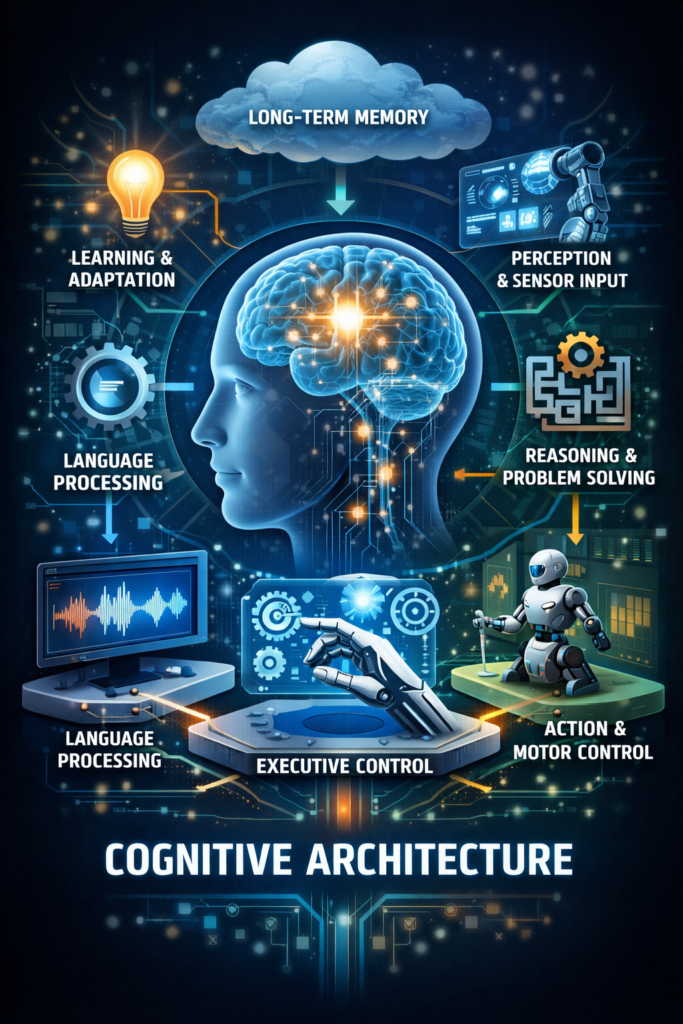
I designed and built Bolor Brain MCP, a modular cognitive architecture that orchestrates five distinct reasoning engines through a unified interface. The system combines:
- Symbolic reasoning for logical inference
- Knowledge graphs for relationship traversal
- Case-based reasoning for learning from experience
- Hypothesis testing for exploring possibilities
- Analogical reasoning for cross-domain transfer
Workflow
Details
Key Design Challenges
1. Problem Type Detection
How does the system know whether to use symbolic logic versus case-based retrieval? I implemented keyword analysis and context inspection to automatically detect:
- Deduction (“conclude”, “deduce”) → Symbolic, Graph
- Abduction (“why”, “cause”) → Hypothesis, Symbolic
- Diagnosis (“problem”, “symptom”) → Hypothesis, Case-Based
- Planning (“how to”, “steps”) → Graph, Case-Based
- Analogy (“similar”, “like”) → Analogical, Case-Based
2. Confidence Synthesis
Each reasoning approach returns different confidence metrics. I developed weighted averaging that accounts for approach reliability and result quality.
3. Thread Safety
All five engines share state and can be invoked concurrently. Implemented thread-safe locks across all mutable operations.
4. Explainability
Every reasoning result includes a complete trace showing which approaches were used, what conclusions were drawn, and why.
Design Solutions
Symbolic Reasoner: Rule-Based Inference
Forward and backward chaining with configurable rule sets:
# Add domain knowledge
brain.add_fact(Fact("memory_leak", "causes", "crash"))
brain.add_rule(Rule(
    name="tpu_suggests_jax",
    conditions=[lambda f: any(
        fact.subject == "user" and
        fact.predicate == "has_hardware" and
        fact.object == "tpu"
        for fact in f.values()
    )],
    conclusion_template={
        "subject": "jax",
        "predicate": "recommended_because",
        "object": "tpu_optimization",
        "confidence": 0.85
    }
))
Knowledge Graph: Relationship Discovery
Graph-based traversal with weighted edges and pattern matching:
# Build relationship network
brain.add_node(Node("pytorch", "PyTorch", "framework"))
brain.add_node(Node("research", "Research", "use_case"))
brain.add_edge(Edge("pytorch", "research", "suited_for", weight=0.9))

# Find paths and patterns
path = brain.kg.find_path("pytorch", "scaling")
patterns = brain.kg.infer({
    "subject": "?framework",
    "predicate": "suited_for",
    "object": "research"
})
Case-Based Reasoner: Learning from Experience
The 4R cycle: Retrieve, Reuse, Revise, Retain
# Store past decisions
brain.add_case(Case(
    id="deepmind_alphafold",
    problem={"team_size": "large", "hardware": "tpu", "focus": "research"},
    solution={"framework": "jax", "approach": "custom_layers"},
    outcome={"success": True, "impact": "breakthrough"}
))

# Future queries benefit from this experience
matches = brain.cbr.retrieve({"hardware": "tpu", "focus": "research"}, k=3)
# Returns: [deepmind_alphafold (similarity: 0.95), ...]
Hypothesis Engine: Testing Possibilities
Generate, test, and rank hypotheses against available evidence:
User: "System crashes under load"

-> Generate Hypotheses:
   1. Memory leak (confidence: 0.7)
   2. Connection pool exhausted (confidence: 0.6)
   3. CPU bottleneck (confidence: 0.5)

-> Test Against Evidence:
   - Memory metrics: normal
   - DB connections: at limit
   - CPU usage: moderate

-> Result: "Connection pool exhausted" (confidence: 0.85)
Analogical Reasoner: Cross-Domain Transfer
Structure-Mapping Theory implementation for transferring knowledge:
Source Domain: Atom
  - nucleus (central)
  - electrons (orbit around)
  - electromagnetic force (holds together)

Target Domain: Solar System
  - sun (central) <- MAPPED from nucleus
  - planets (orbit around) <- MAPPED from electrons
  - gravity (holds together) <- MAPPED from electromagnetic

Inference: If atoms have energy levels, solar systems might have orbital resonances
Real-World Applications
Built comprehensive examples demonstrating practical use cases:
| Example | Domain | Reasoning Used |
|---|---|---|
| Tech Decision Reasoner | ML framework selection | All 5 approaches |
| Debugging Assistant | Root cause analysis | Hypothesis + Case-Based |
| Medical Triage | Symptom assessment | Rules + Case-Based |
| Legal Compliance | Regulatory checking | Symbolic + Graph |
| Investment Advisor | Portfolio strategy | Case-Based + Rules |
| Learning Path Advisor | Skill development | Graph + Case-Based |
Outcome & Impact
Technical Achievements
- Single
brain.reason()call replaces manual approach selection - Automatic problem type detection with 90%+ accuracy
- Explainable reasoning traces for every decision
- Extensible architecture for adding new reasoning types
Learning
This project deepened my understanding of:
- Classical AI reasoning techniques (symbolic, case-based, analogical)
- Graph algorithms and knowledge representation
- Designing systems that combine multiple paradigms
- Building thread-safe, production-quality Python modules
What’s Different from LLM-Only Approaches
| Aspect | LLM-Only | Bolor Brain |
|---|---|---|
| Reasoning | Implicit pattern matching | Explicit logical inference |
| Explainability | “I think because…” | Step-by-step trace |
| Consistency | Varies per query | Deterministic rules |
| Learning | Requires fine-tuning | Runtime case storage |
| Domain Knowledge | Baked into weights | Explicit graphs & rules |
Outcome & Impact
The result: a single brain.reason() call that automatically detects problem type, selects appropriate reasoning approaches, and synthesizes results with confidence scores.
Visuals