Month: September 2025

  • How to Disappear in the Age of AI Surveillance: Escaping the All-Seeing Eye

    Introduction: Living in the Age of Constant Watch

    We live in a world where being watched is no longer the exception—it’s the default.

    • Cameras are everywhere, and they don’t just record—they recognize.
    • AI systems don’t just see your face—they track your gait, your clothing, your body language.
    • Phones and IoT devices constantly leak your location through Wi-Fi, Bluetooth, and cellular signals.
    • Governments and corporations are building real-time digital twins of you—profiling everything from your shopping habits to your political leanings.

    The dream of “anonymity” seems impossible in this landscape. But history shows that every system of control has cracks. Just as some people disappear from debt collectors, journalists protect their sources, or whistleblowers leak without being caught, it is possible to minimize your visibility, confuse AI systems, and reclaim freedom.

    This guide will explore how.


    Why AI Makes Disappearing Harder Than Ever

    In the past, anonymity meant deleting your accounts, paying in cash, and avoiding CCTV. Today, that’s not enough. AI has changed the game:

    1. Facial Recognition – Modern AI can identify faces in milliseconds, even with masks or hats.
    2. Gait Analysis – Your walking style is as unique as a fingerprint. AI can track you by body movement.
    3. Radio Wave Tracking – Devices and even human bodies emit unique signals that can be mapped.
    4. Voice Recognition – Microphones in phones, smart devices, and cameras can identify you by tone and pattern.
    5. Behavioral Profiling – AI builds a profile of your habits: where you go, when you go, how you pay, what you read.

    Disappearing in this environment isn’t about “going dark”—it’s about outsmarting the machines.


    The Principles of Disappearing in an AI-Driven World

    1. Blend, Don’t Vanish
      • Disappearing completely draws suspicion. Instead, blend into the noise. Be “just another person” in the system.
    2. Obfuscation
      • Feed the system bad data. Confuse algorithms with misinformation, noise, and false trails.
    3. Minimization
      • The less you produce (data, activity, patterns), the less there is to profile.
    4. Compartmentalization
      • Keep each identity separate—never let your old and new footprints cross.

    Step 1: Erase the Old You

    Before you can disappear, you need to wipe the obvious traces:

    • Delete social media accounts or flood them with random, misleading information before shutting them down.
    • Opt out of data brokers (or use services like DeleteMe/OneRep).
    • Remove personal websites, blog posts, and old forum accounts where possible.
    • Request removals from Google search results (EU “Right to Be Forgotten,” or US DMCA-based takedowns).

    This won’t erase everything—but it reduces your “searchable shadow.”


    Step 2: Masking Against AI Vision

    AI-driven cameras are the hardest surveillance system to beat. They don’t get tired, they don’t forget, and they share data across networks.

    Countermeasures:

    • Face Obscuration – Hats, masks, and glasses still work in some cases, but AI can now reconstruct faces. Use adversarial fashion (clothing designed to confuse AI).
    • Infrared Accessories – Glasses or headbands that emit IR light (invisible to humans) can blind camera sensors.
    • Crowd Blending – Stick to groups. AI struggles when multiple people overlap.
    • Movement Disguise – Alter your walking style to trick gait recognition (limping, changing stride length).

    👉 Goal: Not to be invisible, but to be misclassified. AI systems are only as useful as their accuracy. If you’re tagged as “unknown” or “low confidence,” you’ve won.


    Step 3: Escaping Radio & Device Tracking

    Your phone is the greatest spy in your pocket. Even powered off, some modern phones still transmit signals.

    How to disappear from radio-wave profiling:

    • Ditch the Smartphone – Use a burner phone paid in cash. Only turn it on when needed, and never near your real identity.
    • Faraday Bags – Block all signals by storing devices in Faraday pouches.
    • No Wi-Fi or Bluetooth – These leak identifiers even when not actively used.
    • Multiple Devices – Use separate burners for separate identities.

    Even better: learn to live without a phone when possible.


    Step 4: Voice & Audio Shielding

    Smart assistants, doorbell cameras, and microphones can identify your voice.

    Countermeasures:

    • Use voice changers when calling.
    • Avoid long conversations in public.
    • Play ambient noise or use white-noise apps to confuse audio collection.
    • Never activate smart speakers or IoT microphones.

    Step 5: Financial Ghosting

    Money creates one of the strongest trails.

    Rules for disappearing financially:

    • Pay in cash only whenever possible.
    • Buy prepaid debit cards or gift cards with cash for online purchases.
    • Use privacy coins like Monero (XMR) for digital transactions.
    • Avoid mixing old financial accounts with new ones.
    • Limit banking—most accounts are deeply tied to government ID.

    The fewer transactions in your name, the harder it is to profile you.


    Step 6: Movement & Location Privacy

    Modern AI links together cameras, transit systems, and license plate readers to follow you in real time.

    How to resist:

    • Use cash for all transport.
    • Walk, bike, or take public buses instead of ride-share apps.
    • Avoid predictable routines.
    • If driving, rotate cars, plates, or avoid highways filled with ANPR (automatic number plate recognition).
    • Consider rural or low-surveillance zones for relocation.

    Step 7: Building a New Identity

    Disappearing isn’t just about vanishing—it’s about becoming someone else.

    • Create new digital identities with unique emails, usernames, and devices.
    • Keep strict separation between old and new.
    • Build “cover activity”—harmless hobbies, posts, or conversations under your new name to normalize it.
    • Never reuse old patterns (don’t write in your old style, don’t use your old shopping habits).

    AI thrives on linking patterns—so change yours.


    Step 8: Obfuscating the Profile

    If governments and corporations are constantly profiling you, fighting back means feeding them junk.

    • Use click farms & bots to flood your data trail with nonsense.
    • Search random topics unrelated to you.
    • Carry a second “dirty phone” that constantly leaks fake GPS movements.
    • Share misleading info in surveys, forms, and online activity.

    If the system insists on building a digital twin of you—make it a useless, chaotic one.


    The Limits of Disappearing

    Let’s be realistic:

    • If you’re targeted by a nation-state, they will find you.
    • Public records (birth certificates, tax filings, property ownership) can’t be erased.
    • Some traces always remain.

    But here’s the truth: you don’t need to be perfectly invisible—just invisible enough to fall below the threshold of interest. Most corporations and even governments automate their surveillance. If your profile is inconsistent, inaccurate, or expensive to track, they’ll move on to easier targets.


    Conclusion: Becoming a Ghost in the Machine Era

    We live in a world where AI surveillance is everywhere—in the sky, on the street, and in your pocket. To disappear today isn’t about vanishing entirely—it’s about learning to bend the rules of the system.

    You can:

    • Erase your old footprints.
    • Mask yourself against cameras and sensors.
    • Break free from device tracking.
    • Live financially and socially off-grid.
    • Feed AI profiles with garbage until they collapse.

    The goal isn’t to be James Bond. It’s to be a shadow in plain sight—unremarkable, untraceable, and ultimately free.

    In an AI-driven world, disappearing isn’t about leaving. It’s about never being found in the first place.
  • The Future of Work: Navigating Automation’s Impact and Empowering Labor with FluentAPI

    Introduction

    As technology relentlessly advances, the landscape of work is undergoing a profound transformation. Automation, once a distant concept, is now an undeniable reality, reshaping industries and redefining job roles. While automation promises increased efficiency and productivity, it also presents significant challenges, particularly for the labor market. This blog post delves into the multifaceted impact of automation on jobs, explores the personal struggles faced by individuals in this evolving environment, and introduces FluentAPI – a novel solution designed to bridge communication gaps and empower workers in the new economy.

    The Shifting Sands of the Labor Market: Automation’s Double-Edged Sword

    The rise of automation, driven by advancements in artificial intelligence (AI) and robotics, has sparked considerable debate about its effects on employment. On one hand, automation is hailed as a catalyst for economic growth, leading to increased productivity, reduced costs, and the creation of new industries and job categories. Tasks that are repetitive, dangerous, or require high precision are increasingly being handled by machines, freeing human workers for more complex, creative, and interpersonal roles.

    However, the rapid pace of automation also brings significant disruption. Many traditional jobs, particularly those involving routine or manual tasks, are susceptible to displacement. Reports from institutions like Goldman Sachs and the World Economic Forum estimate that millions of jobs worldwide could be exposed to automation in the coming years [1, 2]. This displacement is not merely a theoretical concern; it has tangible consequences for individuals and communities. Workers, especially those in sectors heavily impacted by automation, may face the daunting challenge of re-skilling or finding entirely new career paths. This can be particularly challenging for individuals who may lack access to educational resources, or who face language barriers in new job markets.

    Beyond job displacement, automation can also influence wage negotiations and income inequality. Some research suggests that the threat of automation can weaken workers’ bargaining power, potentially dampening wage adjustments [3]. While automation can lead to overall economic gains, the benefits are not always evenly distributed, potentially exacerbating existing disparities.

    It is crucial to recognize that the impact of automation is not uniform across all industries or demographics. Data-rich industries, for instance, are often more prone to disruption by AI, while others may be scrambling to digitize to reap the benefits of automation [4]. The narrative is complex, with some studies even suggesting that AI use at work can increase job satisfaction by freeing workers from mundane tasks [5]. Nevertheless, the overarching trend points to a significant restructuring of the global labor market, necessitating proactive measures to support workers through this transition.

    A Personal Struggle: The Human Face of Automation’s Impact

    The abstract discussions about job displacement and economic shifts often overlook the deeply personal impact of these changes. I recently witnessed this firsthand through a close friend’s struggle. Despite possessing advanced degrees and a strong work ethic, he found himself increasingly marginalized in a labor market that was rapidly automating tasks he once performed. Even seemingly simple jobs like ride-sharing, delivery, and shopping, which once offered a lifeline to many, are becoming less accessible due to technological advancements.

    His situation was compounded by a common challenge faced by many talented individuals from diverse backgrounds: a language barrier. While proficient in his native tongue, his English fluency was not sufficient for roles requiring constant, nuanced communication. This put him at a significant disadvantage, making it incredibly difficult to secure stable employment and provide for his family. His story is not unique; countless individuals, some with impressive qualifications from their home countries, face similar hurdles when navigating new linguistic and cultural landscapes.

    This personal experience spurred me to action. I began to brainstorm ways to leverage technology to create new opportunities, particularly in service-oriented sectors. The idea was to develop a slightly different kind of ride-sharing experience, one that my friend could offer as a valuable service. The initial architectural phase, focusing on workflows and user experiences, took a month of dedicated effort. I meticulously designed a system that would connect service providers with clients, ensuring a seamless and efficient interaction.

    However, as the project neared completion, I encountered a critical roadblock: the very communication barrier I was trying to circumvent. The service I envisioned inherently required clear and effective communication between the service provider (my friend) and the client. His limited English proficiency threatened to undermine the entire endeavor. This was a problem that needed an immediate and innovative solution if the project was to move forward.

    FluentAPI: Bridging the Communication Gap in the New Economy

    The challenge of seamless communication in a multilingual service environment became the central focus of my efforts. I realized that for my friend’s service to be viable, and for countless others facing similar linguistic hurdles, there needed to be a way for service providers and clients to communicate effortlessly, regardless of their native languages. The solution that emerged from this necessity is FluentAPI.

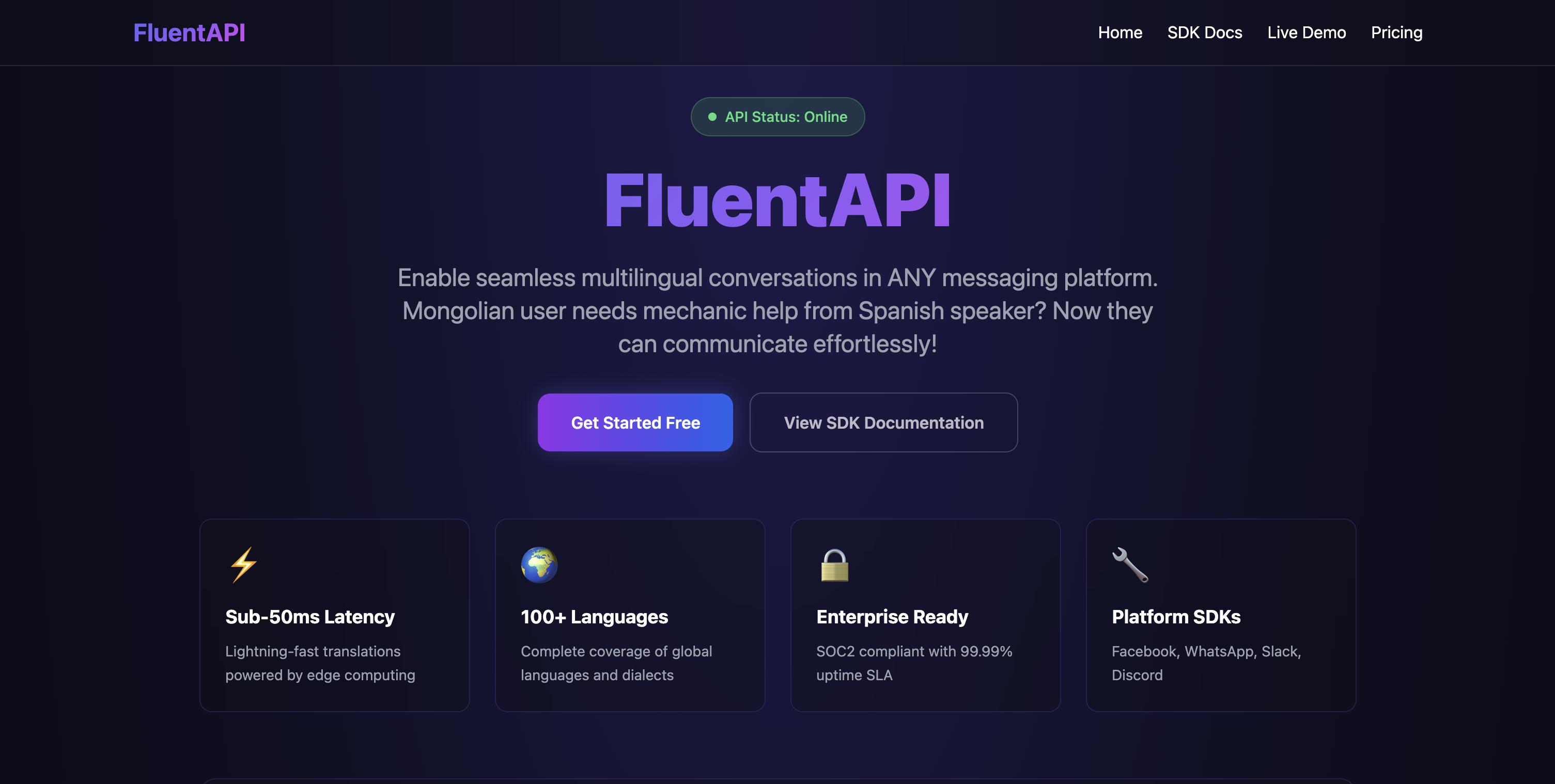
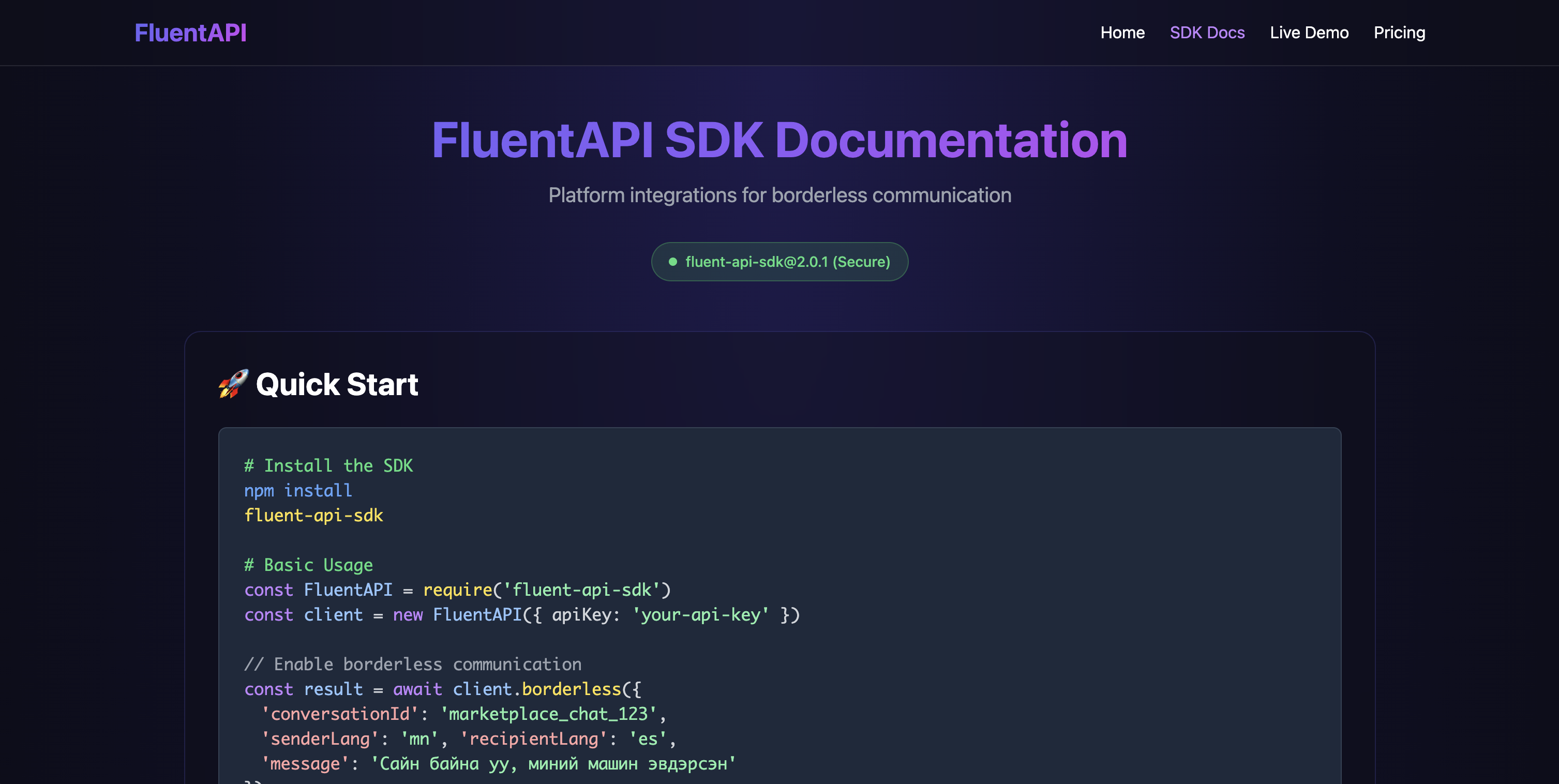
    FluentAPI is an innovative API designed to provide flawless, instant translation services that can be easily integrated into any existing platform. The core idea is simple yet powerful: users on both sides of a communication exchange can write in their native languages, and FluentAPI handles the real-time translation, creating an experience so smooth it feels as if they are conversing directly in the same language. This eliminates the need for service providers to be fluent in the client’s language, and vice-versa, opening up a world of opportunities for skilled individuals who might otherwise be excluded from certain service industries due to language barriers.

    I quickly realized that this solution had far broader implications than just my friend’s ride-sharing service. Many developers and businesses are grappling with similar communication challenges in an increasingly globalized world. Whether it’s for customer support, e-commerce, collaborative platforms, or indeed, other service-oriented applications, the need for seamless, real-time multilingual communication is paramount. FluentAPI was born out of this recognition, offering a robust and easy-to-integrate solution for anyone looking to break down language barriers and foster more inclusive and efficient interactions.

    By providing a reliable and accessible translation layer, FluentAPI empowers individuals from diverse linguistic backgrounds to participate more fully in the digital economy. It transforms what was once a significant obstacle into a non-issue, allowing talent and service to flow freely across linguistic divides. This not only benefits individual workers by expanding their employment opportunities but also enriches the service landscape by making a wider pool of skilled professionals available to consumers.

    Conclusion: A Future of Inclusivity and Opportunity

    The narrative surrounding automation often focuses on job losses and economic disruption. While these are valid concerns that demand our attention and proactive solutions, it is equally important to recognize the potential for technology to create new pathways to opportunity and foster greater inclusivity. FluentAPI stands as a testament to this potential, demonstrating how thoughtful technological innovation can address real-world challenges and empower individuals.

    By enabling seamless communication across language barriers, FluentAPI not only helps individuals like my friend to thrive in the evolving labor market but also provides a valuable tool for developers and businesses worldwide. It is a step towards a future where talent is recognized and utilized regardless of linguistic background, where services can be delivered efficiently and effectively to a global clientele, and where the benefits of technological advancement are shared more broadly. The journey to a more inclusive and equitable future of work is ongoing, and solutions like FluentAPI are crucial in paving the way.

    Start Free Trial | View Documentation | Try Live Demo