Author: bolorerdene

  • QiPAI Store: Persistent Quantum State Storage for Quantum-Inspired AI

    QiPAI Store: Persistent Quantum State Storage for Quantum-Inspired AI

    As quantum-inspired computation becomes more powerful and symbolic, one of the critical challenges is how to persist, organize, and query quantum state data efficiently. Enter qipai-store, the persistent storage layer for the QiPAI framework, designed specifically to handle sparse quantum state tensors, entanglement structures, and rich metadata — all while keeping things fast, compact, and queryable.


    🚀 What Is qipai-store?

    The qipai-store module provides persistent storage and retrieval capabilities for quantum states (QTensor objects) within the QiPAI framework. It aims for efficiency and is designed to handle the specific needs of storing complex amplitudes, entanglement information, and associated metadata.


    🧱 Module Architecture

    The store is organized into several submodules:

    format/

    • qstate.bin.js: Handles encoding/decoding of the primary state binary format.
    • qindex.js: Manages index structures for container files.
    • qmeta.js: Encodes/decodes state metadata (using JSON initially).

    engine/

    • reader.js: Low-level binary reader (potentially stream-based).
    • writer.js: Low-level binary writer.
    • compressor.js: Optional compression algorithms (RLE, Gzip, etc.).

    fs/

    • flatfile.js: One state per file strategy.
    • container.js: Multiple states within a single indexed file.
    • dirmapper.js: Organizes flat files into directories based on IDs/metadata.

    query-engine/

    • queryBuilder.js: Defines the chainable Functional Query API.

    index.js

    • The main public API entry point for the module.

    📦 Binary Format: qstate.bin

    The core storage format is designed to be compact and efficient:

    HEADER (fixed size)

    • Magic number (4 bytes)
    • Version (1 byte)
    • Num Qubits (2 bytes)
    • Sparse Count (4 bytes)
    • Entanglement Group Count (2 bytes)
    • Metadata Length (2 bytes)

    BODY

    • Sparse amplitudes: [index (uint16), real (float32), imag (float32)] × Sparse Count
    • Entanglement groups: [[q1_idx, q2_idx, …], [qA_idx, qB_idx, …], …] (Encoded efficiently)
    • Metadata: UTF-8 JSON blob (or potentially MsgPack)

    This format prioritizes fast access to amplitude data and supports sparse states common in quantum simulations.


    📃 Storage Strategies

    The store supports multiple ways to organize data on disk via the strategy option in saveState and loadState:

    • flatfile: Simple, one .qstate.bin file per quantum state.
    • container: Efficient for many states. Stores multiple states in one large file with an internal index.
    • dirmapper: Uses flat files but organizes them into directories based on stateId or metadata.

    🧠 Functional Query API

    The primary way to interact with stored states beyond simple load/save is the Functional Query API, accessed via the query() method exported by qipai-store/index.js.

    const qb = qStore.query({ storageOptions: { strategy: 'dirmapper', path: './data/run1' } });

    🔎 Filtering Methods

    • .whereMetadata({ key: value })
    • .wherePhaseNear(targetPhase, tolerance?)
    • .whereAmplitudeAbove(threshold, qubitIndices?)
    • .entangledWith(qubitIndexOrGroup)

    🛠 Action Methods (Conceptual)

    • .entangle(target)
    • .interfere(otherState)
    • .measure(basis, targetQubits)
    • .collapse()

    🧪 Execution Methods

    • .limit(count)
    • .sort(field, direction)
    • .listIds()
    • .run()
    • .output()

    ✅ Example

    import * as qStore from './qipai-store/index.js';
    
    const results = await qStore.query({
      storageOptions: { strategy: 'dirmapper', path: './states/exp_C' }
    })
      .whereMetadata({ status: 'processed', type: 'memory' })
      .entangledWith(0)
      .limit(5)
      .run();
    
    console.log(`Found ${results.length} states.`);

    🔬 Semantic Search (Conceptual)

    A planned advanced feature is interference-based semantic search — finding states that constructively interfere with a given input state:

    const similarStates = await qStore.interferenceSearch({
      storageOptions: { strategy: 'container', path: './memory.qdb' },
      inputState: currentThoughtState,
      basis: "meaning",
      maxResults: 10
    });

    ⚡ Performance Optimizations for Large-Scale Quantum States

    🧹 Sparse Quantum Tensor Representation

    The QTensorSparse class provides a memory-efficient way to store quantum states:

    const sparseTensor = new QTensorSparse({
      numQubits: 30,
      nonzeroAmplitudes: new Map([
        [0, qMath.complex(0.7071, 0)],
        [1073741823, qMath.complex(0.7071, 0)]
      ])
    });
    
    const memoryStats = sparseTensor.getMemoryComparison();
    // { sparse: 40 bytes, dense: 17GB+, savings: ~99.9999998% }

    🌐 Distributed Architecture for Massive Scale

    QiPAI-Store includes a sharded, horizontally scalable architecture:

    const store = new DistributedQStore({
      metadata: {
        type: 'elasticsearch',
        endpoints: ['http://elasticsearch:9200']
      },
      stateStorage: {
        type: 's3',
        config: { bucket: 'quantum-states', region: 'us-west-2' },
        shardingFactor: 32
      }
    });

    📄 QiPAI-Store as a Standalone Quantum Database

    A prototype server is available that exposes HTTP endpoints:

    • GET /api/states
    • POST /api/states
    • GET /api/states/:id
    • POST /api/qql

    JavaScript client library:

    const client = new QStoreClient();
    await client.createState({
      id: 'bell_state_01',
      numQubits: 2,
      metadata: { name: 'Bell State |00⟩ + |11⟩' },
      amplitudes: {
        0: { re: 0.7071, im: 0 },
        3: { re: 0.7071, im: 0 }
      }
    });

    📜 Quantum Query Language (QQL)

    QQL is a symbolic DSL that abstracts quantum data operations into readable scripts. Currently implemented commands:

    LOAD STATE s
    WHERE s.metadata.tag = "apple"
    USING STORE { strategy: 'flatfile', path: './data/apple.qstate.bin' }
    
    INTERFERE s WITH input_state
    ENTANGLE s WITH "fruit"
    MEASURE s ON QUBITS [0, 1]
    RETURN LAST_RESULT

    📘 Advanced Example with X-basis

    LOAD STATE s
    WHERE s.metadata.tag = "apple"
    USING STORE { strategy: 'flatfile', path: './data/apple.qstate.bin' }
    
    ENTANGLE s WITH "fruit"
    INTERFERE s WITH input_state
    MEASURE s IN BASIS_X ON QUBITS [0, 1]
    RETURN COLLAPSE s

    This DSL is ideal for configuration files, research pipelines, and AI-directed memory access.


    🔍 Looking Ahead

    QiPAI-Store is well on its way to becoming the world’s first domain-specific database for quantum-inspired computation. With performance tuning, distributed support, symbolic query languages, and real-world application potential in quantum chemistry, simulation, and cognitive systems — it’s designed for the next generation of intelligent software.

  • Computational Efficiency in QiPAI vs Neural LLMs

    Computational Efficiency in QiPAI vs Neural LLMs

    Abstract

    As Large Language Models (LLMs) dominate the AI landscape, their immense compute requirements have become a bottleneck for sustainability, accessibility, and deployment. QiPAI (Quantum-Inspired Particle AI) introduces a fundamentally different approach — replacing brute-force parameter scaling with dynamic phase-evolving sparse states, symbolic reasoning, and quantum-inspired entanglement dynamics. This section compares the computational profiles of QiPAI and LLM-based systems, highlighting how QiPAI achieves greater efficiency, adaptability, and reasoning depth with significantly lower resource demands.


    ⚠️ 1. The Inefficiency of Neural LLMs

    Modern LLMs such as GPT-4, Claude, and Gemini rely on:

    • Hundreds of billions of parameters stored as dense matrices
    • Millions of GPU-hours for training
    • Token-by-token inference, even for deterministic knowledge
    • No persistent memory — they reprocess context for every prompt
    • Shallow reasoning compensated by massive scale
    ResourceGPT-3GPT-4Notes
    Parameters175B~1T?Heavily guarded
    FLOPs (training)~3.14×10²³>>10²⁵Equivalent to ~10 million A100 GPU-hours
    RAM350 GB+1 TB+For inference servers
    Energy~500 MWh+~GWh+Costly and environmentally unsustainable

    ⚛️ 2. QiPAI: Quantum-Inspired Sparse Evolution

    QiPAI radically departs from classical LLM architectures by using:

    • Phase-aware sparse state representations
    • Dynamic symbolic reasoning instead of token prediction
    • Entanglement as an information linkage strategy
    • Continuous-time evolution rather than static layers
    • Probabilistic measurement instead of deterministic decoding

    These design choices allow:

    • On-demand memory construction
    • No need to tokenize or sequence data exhaustively
    • Dynamic learning without retraining entire networks
    • Truly parallel agent reasoning with shallow hardware footprint

    ⚙️ 3. Side-by-Side Comparison

    FeatureNeural LLMs (GPT/Claude)QiPAI
    Parameters100B+ dense weights~1M symbolic + sparse phase elements
    Inference CostGigaFLOPs/tokenAdaptive, phase-evolved per reasoning path
    MemoryToken window reprocessingEntangled symbolic memory (persistent)
    RepresentationReal-valued tensorsComplex phase + amplitude sparse states
    Reasoning DepthSurface-level, via chain-of-thought promptsDeep, structured symbolic + phase propagation
    AdaptabilityRequires fine-tuningOnline, localized evolution
    Training OverheadCatastrophic forgetting, retraining requiredEvolves modules independently
    Environmental CostEnormous (GPU farms)Sparse compute, energy efficient
    HardwareHigh-end TPU/A100WebGPU, Edge-compatible, WASM-ready

    🌱 4. Sustainability & Accessibility

    LLMs require:

    • Expensive GPUs (A100s, TPUs)
    • 24/7 cloud infrastructure
    • High emissions from training/inference

    QiPAI enables:

    • Edge AI agents (runs in browser, mobile, or low-end devices)
    • Modular, persistent evolution without massive retraining
    • Symbolic and quantum-like learning with sparse, low-power compute

    With QiPAI, a decentralized swarm of intelligent agents becomes possible — something fundamentally infeasible with centralized LLMs.


    🔬 5. Strategic Design Efficiency in QiPAI

    Design PrincipleEfficiency Benefit
    Sparse stateReduces memory footprint and avoids unnecessary computation
    Phase tracking only when neededLazy evolution, minimizes active computation
    Entanglement instead of memory copyingNo duplication, shared phase graphs
    On-demand measurementNo output unless needed, reduces I/O
    Symbolic rules overlayEnables preconditioned inference, skipping learning cycles

    ✅ 6. Conclusion

    LLMs have proven their raw power but at great computational cost. They lack the structure, interpretability, and adaptability necessary for sustainable, distributed intelligence.

    QiPAI represents a next-generation paradigm, one where computation mimics quantum systems:

    • Holistic instead of token-wise
    • Evolving instead of retrained
    • Symbolically grounded instead of statistically derived
    • Efficient, explainable, and truly distributed

    As AI moves toward agent ecosystems, edge intelligence, and long-lived autonomous systems, QiPAI offers the architectural shift we need — from brute force to elegant quantum-inspired efficiency.

  • What Is qip Agent Models?

    What Is qip Agent Models?

    The Future of Personal AI Automations—Simplified.

    Let’s start with the basics.


    🤖 What Are AI Agents?

    When we hear the term agent, we often think about automated workflows—sequences of steps performed on your behalf. And that’s pretty accurate.

    Think of this:
    You want to post a message to Twitter every morning at 7AM. Traditionally, you’d:

    1. Write the content.
    2. Select an image.
    3. Schedule a post via a social media tool.
    4. Set a time (cron job).
    5. Repeat this daily.

    Years ago, social media automation platforms followed this exact pattern. You had to provide everything—text, images, schedule—and the system would execute the job at the right time.


    🧠 What Changes with AI?

    Here’s where AI steps in.

    With tools like OpenAI, Gemini, and other LLMs (Large Language Models), you no longer have to write the text or design the image yourself. You can just give the AI a goal—“write a tweet about productivity every morning”—and it can generate the entire post for you.

    Sounds even easier, right?

    But wait…


    ⚙️ What About the Manual Steps?

    As a human, here’s how you’d typically do it:

    1. Open your computer.
    2. Write content.
    3. Open your browser.
    4. Visit Twitter (X).
    5. Log in.
    6. Post.

    You do this every single day.

    An AI Agent, however, can do all of these steps automatically. It can either learn how to perform them or connect via APIs (special access points websites and apps expose for automations).

    But here’s the kicker:
    Every platform has different APIs, different logins, and different rules. That’s a LOT of complexity.


    🚀 Enter: QIP Agents

    QIP Agents are here to simplify that complexity.

    We’re building a platform where you can create AI agents without worrying about APIs, authentication, or technical boilerplate. QIP stands for Quantum-inspired Particle, but more importantly, it’s about building modular, intelligent, personal agents.

    We’re pre-training models that understand:

    • API documentation
    • Authentication flows
    • Action schemas
    • Platform requirements

    And we’re giving you a toolkit:

    • qip.auth.model – handles login/authentication flows
    • qip.memory – remembers what the agent did and knows
    • qip.planner – creates action plans based on goals
    • qip.executor – runs those steps across systems
    • qip.reflection – evaluates what happened, and learns from it

    🧪 Early Agent Pseudocode

    Here’s a sneak peek at what building a QIP Agent might look like under the hood:

    Looks simple? That’s the point.


    🧭 What’s Next?

    We’re building a drag-and-drop agent builder so that anyone—technical or not—can launch their own AI automations.

    Whether you want a bot that:

    • Posts to multiple platforms
    • Sends you updates
    • Books meetings
    • Monitors your files
    • Or even learns new behaviors

    QIP Agents will make it not just possible—but fun.

  • Introducing QIPAI: Quantum-Inspired Particle AI for the Next Wave of Intelligence

    Introducing QIPAI: Quantum-Inspired Particle AI for the Next Wave of Intelligence

    In an era where traditional AI systems are growing ever more complex and energy-intensive, we ask a bold question:

    What if intelligence could emerge from simplicity?
    What if particles—not transformers—held the key to scalable, adaptive AI?

    Welcome to QIPAI (Quantum-Inspired Particle AI)—an experimental AI framework built from the ground up to be lightweight, adaptive, and fundamentally emergent.


    💡 What is QIPAI?

    QIPAI is a physics-inspired alternative to conventional AI models like transformers or diffusion models. It doesn’t rely on massive datasets or GPU farms. Instead, it simulates intelligent behavior using minimal, particle-based agents that operate through interactions, fields, and environmental feedback—much like particles in quantum physics.

    Imagine a web of particles, each carrying a local behavior, memory, and learning capability. Over time, these particles evolve, communicate, and adapt, forming emergent intelligence that can solve problems, adapt to new environments, and even self-organize into complex patterns of reasoning.


    ⚛️ The Core Principles of QIPAI

    1. Particle-Based Computation
      Each unit of intelligence is modeled as a lightweight particle that observes, reacts, and adapts within a local environment.
    2. Quantum-Inspired Fields
      Interactions are governed by probabilistic fields, much like quantum wavefunctions—allowing for fluid reasoning, uncertainty handling, and parallel processing.
    3. Emergence over Architecture
      Intelligence is not hard-coded. Instead, it emerges from simple rules and iterative feedback, much like life itself.
    4. Low Energy, High Scalability
      QIPAI avoids heavy matrix math and attention stacks. It’s built to run on microcontrollers or edge devices, not just data centers.

    🧠 How Is It Different From Traditional AI?

    FeatureTransformersQIPAI
    ArchitectureStatic & layeredEmergent & dynamic
    TrainingHigh-resource, batchedIncremental, environmental
    IntelligenceEncoded in weightsEmerges from particles
    MemoryExplicit (tokens)Distributed & spatial
    Power useGPU/TPU heavyCPU/JS/light environments
    FlexibilityFinetuned per taskSelf-organizes per goal

    I’m so hopelessly positive. Training comparison between OpenAI VS qipAi

    🌀 Use Case: Autonomous Workflow Orchestration for Enterprise Operations

    One of the most powerful applications of QIPAI and NSAF MCP is in orchestrating autonomous agents that manage and optimize complex enterprise operations in real time. This includes:

    • Supply Chain Intelligence: Agents that navigate logistics APIs, respond to shipping delays, reroute containers dynamically, and sync with internal ERP systems.
    • Autonomous Compliance Handling: React to regulation changes by updating document flows, performing self-audits, and coordinating with external partners—all without human oversight.
    • Finance and Procurement Automation: Agents parse and verify invoices, negotiate contracts, monitor fraud indicators, and coordinate payment timing for optimal cash flow.
    • HR and Talent Coordination: End-to-end hiring, onboarding, training, and performance evaluations handled by symbolic-flow-driven particle agents that adapt to organizational goals.
    • IT Infrastructure Monitoring + Healing: QIPAI-powered agents detect anomalies, simulate multiple fix-paths, coordinate patch deployments, and reroute traffic with minimal downtime.

    🧠 Why It Works

    • NSAF MCP provides symbolic logic graphs, policy adherence, and state-transition modeling (e.g., SLA rules, risk mitigation protocols).
    • QIPAI overlays emergent behavior and adapts on-the-fly to nuanced signals like exceptions, unknown edge cases, and multi-agent decision cascades.

    Together:
    🔁 NSAF = Structure, Regulation, Logic
    ⚛️ QIPAI = Flow, Feedback, Emergence

    This hybrid model doesn’t just “automate tasks”—it learns the organization, evolves with its data, and becomes a digital brain layer between APIs, internal systems, and human staff.


    🔁 Learning From the Environment

    QIPAI agents learn via a component called the ExperienceCollector—a quantum-mapped memory structure that captures feedback (success, failure, delay, response rate, etc.) and feeds it back into the particle field.

    Over time, this allows the system to:

    • Recognize successful patterns
    • Adapt to platform-specific quirks
    • Prioritize effort for high-yield targets
    • Self-optimize with minimal human input

    🧬 Modular Design: Build Your Own Quantum Agent

    QIPAI is modular by design. You can plug in:

    • BinaryAdapter – for converting external signals to field inputs
    • StreamingQuantumTrainer – for real-time reinforcement of patterns
    • ExperienceCollector – to store lessons in particle-compatible memory
    • IntentionResonator (coming soon) – an experimental module to amplify goal-oriented behaviors

    You’re not locked into any stack. QIPAI works with:

    • JavaScript for front-end + emergent canvas logic
    • Node.js for backend logic and quantum scheduling
    • Your custom stack for particle control and visualization

    🌍 Why It Matters

    Most AI frameworks today aim to scale up. QIPAI is different. It aims to scale down while increasing intelligence.

    This means:

    • Running an LLM-style agent on your phone
    • Building trainable edge devices with near-zero cost
    • Teaching a particle agent to master a domain in under an hour
    • Evolving collaborative agents that reason and coordinate autonomously

    🧭 The Road Ahead

    QIPAI is still in its early days. But the vision is clear:

    • Quantum-as-a-Service (QaaS) modules
    • Self-assembling agent swarms
    • Physics-based reinforcement algorithms
    • Unsupervised open-ended learning

    We’re not building another transformer.
    We’re building the first real-time, physics-emergent intelligence engine.

    And you’re invited to co-create it.


    🚀 Get Involved

    Want to contribute, experiment, or deploy QIPAI?

    1. Clone the core modules from GitHub (coming soon)
    2. Check out the example particle systems for inspiration
    3. Start training your own emergent agents—on browser or Node

    Or just reach out if you’re building something wild—we might just build it together.


    QIPAI isn’t just an AI framework. It’s a new way to think about intelligence.

    Let’s explore the quantum edge of cognition—together.

    If you’ve made it this far, I’d love to hear your thoughts—feel free to share your opinion below!

  • Temporary Pause on Brand Strategy Kit Due to High Volume Usage

    Temporary Pause on Brand Strategy Kit Due to High Volume Usage

    Hey everyone,

    We wanted to share an important update:
    We’re temporarily pausing Brand Strategy Kit due to overwhelming demand. 🧠🔥

    Since we’re currently offering the platform for free, the recent surge in usage has resulted in some very big, very real bills from OpenAI. While we absolutely love seeing the interest and support from users around the world, we need a bit of time to sort out infrastructure and funding before we can bring Brand Strategy Kit back online at full speed.

    We’re working hard to find a sustainable solution so we can continue offering this powerful tool — and hopefully keep some level of free access in the future too. Stay tuned!


    🧠 Wait… What Is Brand Strategy Kit?

    If you’re new here and wondering what all the fuss is about — here’s the scoop:

    Brand Strategy Kit is an AI-powered platform that helps you craft your brand identity, positioning, messaging, and customer insights — all in one place, and lightning fast.

    Whether you’re a startup, entrepreneur, creative, or agency, the toolkit can guide you through:

    • 🎯 Defining your brand purpose and positioning
    • 🧩 Clarifying your value proposition
    • 🎨 Discovering your brand tone, voice, and personality
    • 👥 Identifying your target audience and personas
    • 📣 Crafting compelling messaging for marketing, websites, and pitches

    It’s like having your own brand strategist, copywriter, and creative director — all powered by AI and optimized to help you move fast and strategically.


    ⚡ Why People Love It

    Users have said things like:

    “This helped me go from messy ideas to a polished brand strategy in one evening.”

    “I used this to prep for a pitch — and nailed it.”

    It’s designed to be simple, smart, and actionable — cutting through the noise and giving you tools that actually help you build a brand that resonates.


    💬 What’s Next?

    We’re working on:

    • More cost-efficient architecture
    • Possible paid tiers for power users
    • And some exciting new features behind the scenes 👀

    Thanks for all the love and support — we’re just getting started. 💪

    Stay bold,
    — The Brand Strategy Kit Team

  • Integrating a “Learn to Learn” Feature (Curiosity-Driven Loop)

    Integrating a “Learn to Learn” Feature (Curiosity-Driven Loop)

    Concept Overview:

    A “Learn to Learn” feature would introduce a curiosity-driven, self-improving loop on top of NSAF’s existing capabilities. Currently, NSAF evolves agents for a given objective when instructed; with a Learn-to-Learn extension, the system itself would autonomously seek new knowledge and improvements over time. This can be seen as an outer loop around the current evolutionary process – a loop that decides when and what to learn next, driven by curiosity or an intrinsic reward, rather than being entirely task-driven by external requests.

    Proposed Architecture Extension: We can introduce a new component, say a Learning Orchestrator or Meta-Learning Agent, that supervises repeated runs of the Evolution process:

    • Lifecycle Hooks: Enhance the Evolution engine to include hooks at key points (e.g. end of each generation, or end of each full evolution run). These hooks would allow a higher-level agent to observe progress and results. For example, after each generation, a hook could compute statistics about the population (diversity, convergence, novel features) and log them to a knowledge store. After an evolution run completes, a hook could trigger analysis of the best agent and how it was achieved.
    • Curiosity Module: Implement a module that evaluates the system’s knowledge gaps and formulates new goals. This could be as simple as measuring stagnation – if multiple evolution runs yield similar results, the system might decide to change the task or vary parameters. Or it could be more complex, like generating a new synthetic dataset that challenges the current best agent (for instance, if the agent performs well on one distribution, the orchestrator could create a slightly different task to force the agent to adapt, thereby learning to be more general).
    • Daily Scheduled Runs: Utilize a scheduler (in the Node layer or via a persistent Python loop) to trigger learning sessions at regular intervals (e.g., daily). For instance, the MCP server could start a background thread that every 24 hours wakes up and initiates a new evolutionary experiment aimed at improving the agent’s capabilities. The results of each daily run would be fed into the symbolic memory (see below) before the system sleeps until the next cycle. This is analogous to a cron job for self-improvement.
    • Symbolic Memory / Knowledge Base: Alongside the neural components, maintain a symbolic memory – a structured record of what has been learned over time. This could be a simple database or file where the system stores outcomes of experiments, discovered rules, or meta-data about agent performance. For example, the system might log entries like: “Architecture X with depth 5 consistently outperforms deeper architectures on task Y” or “Mutation rate above 0.3 caused instability in training”. These pieces of information can be stored in a human-readable format (JSON or even logical predicates) and serve as accumulated knowledge.
    • Self-Adaptation: With the above pieces, the orchestrator can now adapt the learning process itself. Using the symbolic memory, the system can adjust its hyperparameters or strategies for the next run – effectively learning how to learn. For example, it might notice that one type of neural activation function often led to better fitness; the next day’s evolution can then bias the initial population to include more of that activation, or update the mutation operators to favor that trait. Alternatively, the system might cycle through different fitness functions or learning tasks to broaden its agents’ skills (a form of curriculum learning decided by the AI itself).

    Integration into NSAF MCP Server: To add this feature, we would extend both the Python core and possibly the Node interface:

    • Python Side: Create a new class, perhaps CuriosityLearner or AutoLearner, which wraps the Evolution process. It could accept a schedule (number of cycles or a time-based trigger) and manage the symbolic memory. Pseudocode structure: pythonCopyEditclass AutoLearner: def __init__(self, base_config): self.base_config = base_config self.knowledge_db = KnowledgeBase.load(...) # load past knowledge if exists def run_daily_cycle(self): while True: # perhaps check if current time is the scheduled time config = self.modify_config_with_prior_knowledge(self.base_config) evolution = Evolution(config=config) evolution.run_evolution(fitness_function=self.get_curiosity_fitness(), generations=..., population_size=...) best = evolution.factory.get_best_agent() result = best.evaluate(self.validation_data) self.update_knowledge(evolution, best, result) self.save_best_agent(best) sleep(24*3600) # wait a day (or schedule next run) In this loop, modify_config_with_prior_knowledge would tweak parameters based on what was learned (for instance, adjust mutation_rate or choose a different architecture complexity if the knowledge base suggests doing so). The get_curiosity_fitness might augment the normal fitness with an intrinsic reward for novelty – e.g., penalize solutions that are too similar to previously found ones, encouraging exploration. update_knowledge would log the outcome (did the new agent improve? what architectural features did it have? etc.), and save_best_agent could maintain a repository of best agents over time (enabling ensemble or recall of past solutions).
    • Symbolic Memory Implementation: A simple approach could be to use JSON or CSV logs for the knowledge base. Each daily run appends an entry with stats (date, config used, best fitness achieved, architecture of best agent, etc.). Over time, the system can parse this log to find trends. For a more sophisticated approach, one could integrate a Prolog engine or rule-based system to represent knowledge symbolically (e.g., rules like IF depth>5 THEN performance drops learned from data). This symbolic reasoning could then be used to explicitly avoid certain configurations or try new ones (for instance, a rule might trigger: “No improvement with current strategy; try increasing input diversity”).
    • Node/Assistant Integration: The Learn-to-Learn loop can run autonomously once started, but we can also expose controls via MCP. For example, a new MCP tool command like start_auto_learning could initiate the AutoLearner background loop, and another like query_knowledge could allow the assistant to ask what the system has learned so far (returning a summary of the symbolic memory). Lifecycle hooks would be important to ensure that the assistant is informed of significant events – e.g., after each daily cycle, the system could output a message via MCP indicating “New best agent achieved 5% lower error; architecture features X, Y, Z.” This keeps the human or AI overseer in the loop on the self-improvement progress.

    Daily Cycle Example: Suppose the NSAF MCP Server is running continuously on a server with the Learn-to-Learn feature enabled. Each day at midnight, the AutoLearner triggers an evolution run on a reference task (or a set of tasks). The first day, it starts with default settings; it finds, say, a medium complexity network that achieves a certain score. It logs this. By the next day, the symbolic memory has a baseline. The orchestrator now deliberately, out of curiosity, increases the architecture_complexity to complex and runs again, to see if a deeper network improves performance. If it finds improvement, it logs that deeper was better; if not, it logs that deeper didn’t help. It might also try a completely different synthetic task on day 3 to diversify the agent’s capabilities (ensuring the agent doesn’t overfit to one problem). Over many cycles, the system accumulates knowledge of what architectures and hyperparameters work well under various conditions, effectively tuning its own evolutionary strategy. In doing so it “learns to learn” – it gets better at picking configurations that yield good agents.

    Curiosity-Driven Exploration: A core of this feature is intrinsic motivation. We can implement a simple curiosity reward by, for example, favoring agents in the fitness function that exhibit novel behavior or architecture relative to those seen before. Concretely, the fitness_function could include a term that measures distance from known solutions (one could vectorize an architecture or its performance profile and measure novelty). This means the evolutionary process isn’t just optimizing for an external task (e.g. accuracy on data) but also for surprise or uniqueness. The Knowledge Base aids this by storing fingerprints of past agents. This would gradually expand the variety of solutions the system explores, potentially discovering unconventional architectures that a static fitness alone might miss.

    Symbolic Reasoning Integration: Since NSAF is neuro-symbolic, adding a symbolic layer aligns well with its philosophy. For instance, after several runs, the system might infer a symbolic rule like: “IF dataset is small AND layers > 3, THEN overfitting occurs”. The orchestrator could use such a rule to constrain future generations or to decide to apply regularization. This marries the neural search with higher-level reasoning: the symbolic memory acts as the conscience or guide for the otherwise random evolutionary tweaks.

    Technical Considerations: Integrating this feature requires careful management of state and process:

    • The MCP server would need to remain running persistently (not just per request). We might run the AutoLearner in a separate thread or process to not block the main MCP request loop. Alternatively, run the entire MCP server in a persistent mode where it doesn’t exit after a single command but stays alive (the Claude integration config already sets disabled: false for the server, implying it can stay resident​github.com).
    • Resource management is key – a daily learning loop could be resource-intensive, so the system should either run during idle times or use a reduced workload when running in the background. This could be configured in Config (e.g. smaller population for background learning vs. larger if explicitly requested by user).
    • Checkpointing and persistence become more important: the system should regularly save the state of the AutoLearner (best agents, knowledge base) to avoid losing progress if restarted. The existing agent.save() mechanism​github.com and experiment checkpointing can be leveraged for this.
    • Feedback Loop with Assistant: With the Learn-to-Learn feature, the AI assistant could even ask the MCP server what it has learned or request it to apply its latest best agent to some user-provided data. This tight coupling means the assistant + NSAF become a more autonomous team: the assistant handles communication and high-level decisions, while NSAF continuously improves its low-level capabilities.

    In summary, adding a “Learn to Learn” module would transform the NSAF MCP Server from a one-shot evolutionary tool into a continually self-improving agent framework. It would use lifecycle hooks to monitor itself, schedule regular learning sessions to accumulate improvements, and maintain a symbolic memory of knowledge to drive curiosity and avoid repeating mistakes. For a developer or architect, this extension involves creating new orchestration logic on top of NSAF’s solid foundation: leveraging the modular design to inject higher-level control loops, and using the existing saving, loading, and config systems to support a persistent, evolving knowledge base. The result would be an AI agent that doesn’t just learn once, but keeps learning how to better learn, day after day – pushing the NSAF paradigm toward true continual self-evolution.

  • Neuro-Symbolic Autonomy Framework

    Neuro-Symbolic Autonomy Framework

    Deep Dive into the Neuro-Symbolic Autonomy Framework

    Current Features and System Capabilities

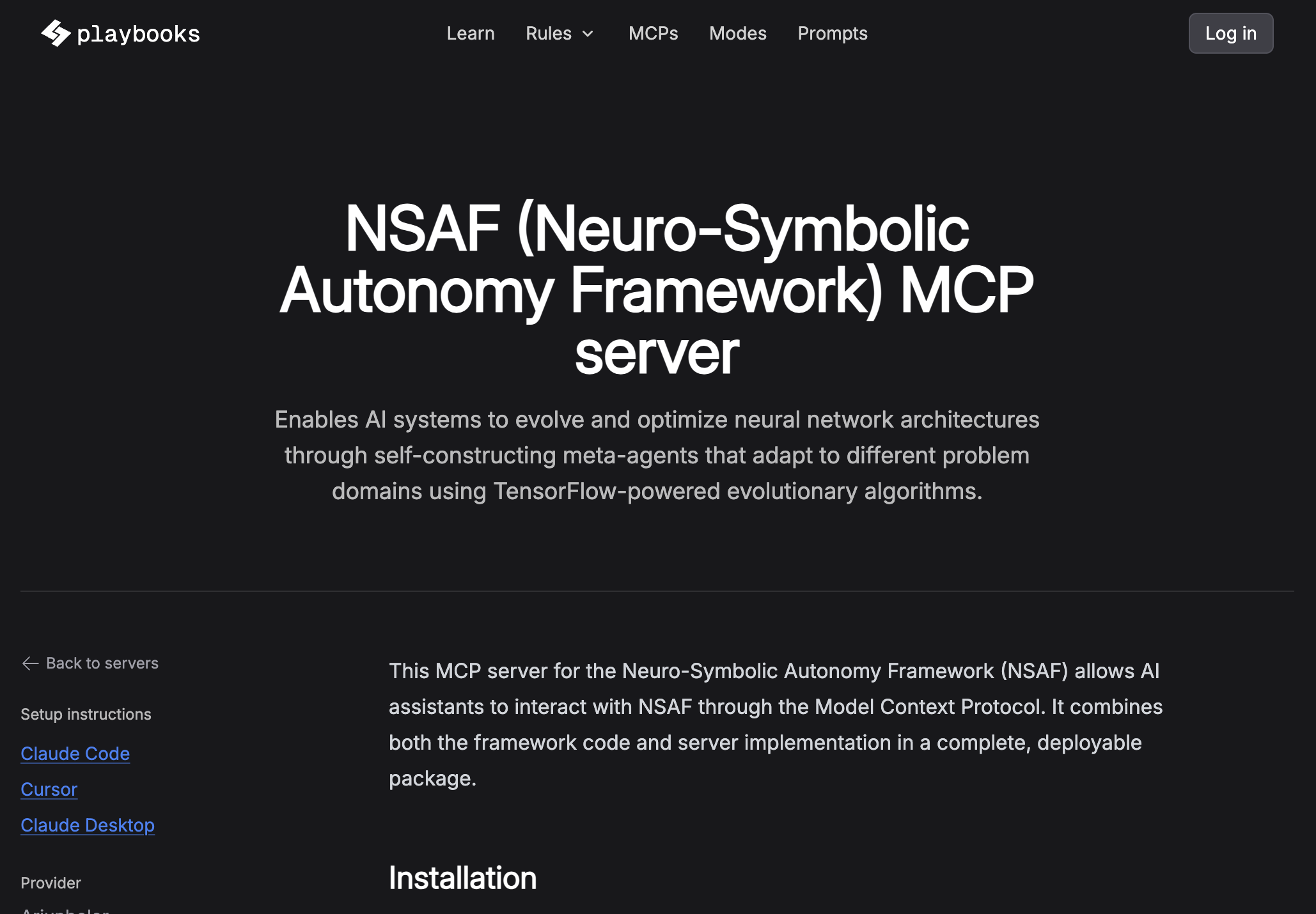
    Neuro-Symbolic Autonomy Framework (NSAF): The NSAF MCP Server integrates neural, symbolic, and autonomous learning methods into a unified system for building evolving AI agents​. It demonstrates the Self-Constructing Meta-Agents (SCMA) component of NSAF, which allows AI agents to self-design and evolve new agent architectures using Generative Architecture Models​. In practice, NSAF’s SCMA creates a population of “meta-agents” (neural network models with various architectures) and optimizes them through simulated evolution.

    Key Features and Tools: The NSAF MCP Server exposes its capabilities through tools that AI assistants (like Anthropic’s Claude or others supporting MCP) can invoke. Major features include​:

    • Evolutionary Agent Optimization: Run an evolutionary loop to optimize a population of AI agent architectures with customizable parameters (population size, generations, mutation/crossover rates, etc.)​. This run_nsaf_evolution tool trains and evolves multiple neural-network agents over generations, producing an optimized “best” agent at the end​.

    • Architecture Comparison: Compare different predefined agent architectures (e.g. simple, medium, complex) using the compare_nsaf_agents tool​. This helps evaluate how network topology or complexity affects performance.

    • Integrated NSAF Framework: The server includes the full NSAF framework code so it runs out-of-the-box without additional setup​. This means all core NSAF classes (for configuration, meta-agent definition, evolution algorithm, etc.) are bundled.

    • Simplified MCP Protocol: Implements a lightweight Model Context Protocol (MCP) interface (without needing the official MCP SDK)​. AI assistants communicate with the server via this protocol, allowing two-way integration. The server can be installed as an NPM package and added to an assistant’s toolset configuration (e.g. in Claude’s settings) so that the assistant can launch it and send commands​.

    • AI Assistant Orchestration: Allows AI assistants to invoke NSAF capabilities from a conversation. For example, an assistant can call run_nsaf_evolution with given parameters to delegate heavy learning tasks to NSAF, then receive the results (such as performance metrics or a summary of the best evolved model)​. This effectively offloads complex model-building workflows to the MCP server while the assistant orchestrates the high-level workflow.

    Meta-Agent Workflows: Under the hood, NSAF uses meta-agents that can design and train neural networks on the fly. Users (or the AI assistant) can customize various aspects of the process:

    • Configurable Evolution – Users can set parameters like population_size, generations, mutation/crossover rates, etc., to control the evolutionary search​. The system uses these to breed and evaluate agents over multiple generations.

    • Fitness Evaluation – The evolution process uses a fitness function to select the best agents. By default, a simple metric (like negative MSE on a task) can serve as fitness​, but the NSAF framework allows custom fitness definitions in code​ (when using NSAF as a Python library).

    • Architecture Templates – NSAF comes with predefined architecture complexities (“simple”, “medium”, “complex”) that vary network depth/layers​. Users can also supply a custom architecture structure (e.g. specific layer sizes, activations) when creating a MetaAgent​.

    • Visualization and Persistence – The framework can visualize agents and evolution progress (e.g. saving model diagrams) and save or load agent models​. This helps in analyzing the evolved solutions or reusing them later.

    Overall, the NSAF MCP Server’s current capabilities center on automated neural architecture search and optimization. It effectively orchestrates a population of learning agents—initializing them, training/evaluating each, and applying genetic operations (mutation, crossover) to produce improved offspring—under the direction of either default settings or user-specified parameters. By exposing these functions through MCP, an AI assistant can trigger complex workflows (like “find me an optimal neural network for this data”) and let the server handle the heavy lifting.

    Github link

  • How NSAF Was Born

    In the last three years, we’ve witnessed one of the biggest shifts in human history — the rise of generative AI.

    Since OpenAI introduced GPT to the world, the pace of innovation has exploded. Today, there’s a constant stream of breakthroughs: new models, new APIs, new tools. AI isn’t just a buzzword anymore. It’s quickly becoming the backbone of how we build, create, and communicate.

    But this level of rapid change brings something else too: overwhelm.

    Every week, there’s another release. Another update. Another framework. For businesses and startups trying to navigate it all, the question becomes:

    Where do we even begin?


    Looking Back: A Familiar Revolution

    To understand the birth of NSAF, let me take you back a little.

    In the late 1990s, I started out in the middle of another revolution — the web. Back then, building websites felt like unlocking magic. HTML, CSS, Flash — each new thing made the internet feel alive. Servers, databases, scripting — it all began to form the digital world we now live in.

    But compared to today’s AI revolution, the web evolved slowly. You had time to learn. Time to adapt. AI doesn’t give us that luxury. This wave is moving faster, with more complexity and more potential impact than anything we’ve seen before.

    And it’s not just for tech companies anymore. Every industry — from health to law, logistics to education — is being reshaped in real-time. Yet the tools to truly build with AI remain out of reach for many. Most of what’s out there are wrappers. Demos. Black-box APIs.

    That’s where NSAF comes in.


    Why NSAF?

    In all this noise, one thing became clear:
    We needed something trustworthy.
    Something transparent.
    Something we could build on — not just use.

    We asked a simple question:

    What if you wanted to build an intelligent system — one that could evolve, adapt, and improve over time — just for your needs?

    Most open-source models are massive. Hard to audit. Slow to fine-tune. And often built with a one-size-fits-all mentality.

    For small teams, startups, or even solo developers, diving into those ecosystems is like trying to rebuild a spaceship just to change its seat covers. You don’t need all that. What you need is a clean foundation.

    That’s what NSAF aims to be:
    A lightweight, modular framework that helps you build your own intelligent agents.
    Agents that can learn. That can reason. That can evolve.


    A Bootstrap for the Future

    NSAF wasn’t built as a product. It was born from necessity.

    It started as an internal idea — a way to prototype agents that could think a bit more deeply, learn over time, and act on their own. But quickly, it grew into something bigger. We stripped it down to the essentials. No dependencies you don’t need. No huge libraries hiding complexity. Just a minimal, neuro-symbolic framework you can actually read, modify, and trust.

    You can:

    • Spin up your own agents
    • Train them on your own terms
    • Even start building your own language models, tailored to your needs

    It’s small enough to audit. Fast enough to experiment. Open enough to grow with you.


    The Road Ahead

    We’re entering an era where AI won’t be optional — it’ll be core infrastructure.

    But here’s the thing:
    The smartest AI for your business won’t come from someone else’s API.
    It will be the one you train.
    The one you understand.
    The one you own.

    That’s the future NSAF was built for.

    Whether you’re a startup looking to integrate smart decision-making into your product, a researcher experimenting with agent-based systems, or a technologist dreaming of self-evolving digital workers — this framework gives you a place to start. Not with all the answers, but with the right questions.


    We’re excited about where this is going — and we hope you are too.

    The future is agentic. The future is adaptive.
    Let’s build it with intention.

    👉 https://github.com/ariunbolor/nsaf-mcp-server/